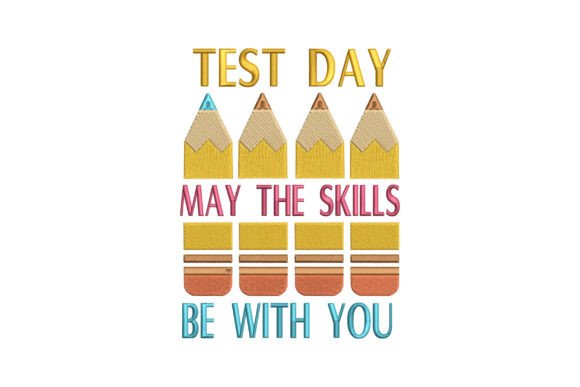
Test Day May the Skills Be with You Review
Every once in a while, a design title stops me mid-scroll. Test Day May the Skills Be with You is that kind of embroidery file. I’m a studio designer for a small boutique brand, and we’re currently planning a limited sweatshirt drop around school motivation themes. The moment I read the name, I knew this had the playful, pop-culture-adjacent charm that appeals to both kids and their parents. It’s not a literal Star Wars piece, but the wink is unmistakable, and that kind of clever wordplay translates beautifully into custom apparel that feels like an inside joke everyone wants to wear.
From a pure design evaluation standpoint, the first thing I ask myself is: will this actually look like a premium finished product on a sweatshirt? Based on the title and the short description—which promises a “delightful” and “vibrant and imaginative flair”—I expect a layout that balances whimsy with a clean, readable composition. For a hoodie design or chest placement on a crewneck, the design needs enough presence to hold its own without overwhelming the garment. Too small, and it disappears on a cozy oversized fit. Too large, and it becomes a billboard. I’m picturing Test Day May the Skills Be with You as a moderately sized, horizontal or slightly stacked typographic design with accent elements—maybe tiny stars, a pencil, or a subtle glow motif. The mood is playful but not messy, cute but not preschool, and that’s a very intentional sweet spot for a boutique brand.
First Impressions on Sweatshirt Fabric
When I test a new machine embroidery design for our apparel line, I always imagine it across three or four fabric scenarios. For a school-themed launch, the hero item is almost always a neutral, mid-weight French terry sweatshirt. I’d start by visualizing Test Day May the Skills Be with You on a heather oatmeal or cream base. Light backgrounds give the thread colors room to breathe, and if the design uses a mix of bright primaries or soft pastel tones, they’ll pop beautifully. The description hints at “vibrant” flair, so I’d lean toward a palette with a cheerful balance—maybe a deep navy or royal blue for the main lettering, accented with sunny yellow or coral. On a pastel pink or mint hoodie, the same design could take on a softer, almost storybook quality, which is perfect for a feminine or handmade aesthetic.
On dark fabric—charcoal, black, deep green—the stakes are higher. Contrast is everything. I’d want to confirm that the thread colors in the original digital embroidery file are mapped with enough lightness to stand out. If the main text is a dark tone, I’d manually recolor to a brighter hue or even a metallic gold for a premium feel. The description doesn’t specify exact thread charts, but most experienced digitizers leave room for creative interpretation. I’d also check for an underlay; on a plush fleece, without proper understitching, the text could sink into the pile and lose definition. This is a key concern: stitch density needs to be high enough to create a crisp surface, but not so dense that the design becomes a stiff board on a garment that’s meant to be cozy.
Placement Possibilities for a Boutique Drop
In our small shop, we rarely stick to a single placement. Test Day May the Skills Be with You reads like a natural chest design—left chest or centered, depending on the final size. For a series of sweatshirt embroidery pieces, I’d absolutely test it at about 3.5 to 4 inches wide for a left-chest logo feel. It’s subtle, commercial, and feels like a classic crewneck detail. But I’d also love to see it scaled up to 5 or 6 inches for a centered chest motif on an oversized hoodie, where the canvas is larger and the design can be more of a statement.
Another placement that could set a boutique apart is sleeve embroidery. A vertical or slightly angled version running down the forearm of a raglan sleeve adds a modern, streetwear-inspired edge. And for a truly unique limited drop, a back design—perhaps paired with a small chest or sleeve hit—transforms a basic hoodie into a collector’s item. The key is to test the design at multiple sizes, and that’s where I always remind myself: without the exact hoop size and file dimensions listed in the product details, I’d need to check the seller’s specs before ordering. The listing description cuts off, but it’s crucial to know whether the design is split into multiple hoopings or intended for a single hooping. For a boutique sweatshirt, I strongly prefer a single-hooping design to keep production clean and efficient.
Stitching Personality and Thread Choices
An embroidery file isn’t just a shape; it has a stitching personality. When I review a design like Test Day May the Skills Be with You, I’m looking at the texture it will bring to the fabric. A satin stitch border on lettering gives a polished, almost glossy finish that feels elevated. Fill stitches can add texture, but too many layered fills can turn a sweatshirt into something that feels plastic-like. I’d want to see a mix of satin and light tatami fills, especially if there are decorative elements like stars or a pencil. The description says “delightful,” which suggests a light, airy feel—maybe even some open spaces within the design that let the fabric color show through. That’s a smart digitizing trick for keeping the design soft and wearable.
Thread color selection is where I can really brand the piece. If we’re aiming for a rustic or minimalist look, I might use a single color (like a matte white or tonal cream) on a textured oatmeal sweatshirt. For a bold or decorative approach, I’d go with a palette that mimics a classic school theme: primary red, royal blue, and bright yellow. The title itself feels like a nod to a galaxy far, far away, so a space-themed palette—deep violet, gold, and silver—would also be stunning for a more premium, limited-edition vibe. What matters is that the file’s color stops are clearly separated, making it easy to recolor without accidentally blending sections.
Practical Production Concerns
Every small shop owner knows that beautiful on-screen doesn’t always mean beautiful on fabric. I’d run a thorough test stitch on a swatch of our actual sweatshirt material before committing to a full production run. Here are the non-negotiables I’d check:
- Stabilizer choice: For a stretchy or loopback sweatshirt fabric, a sturdy cutaway stabilizer is essential. I’d hoop a layer of medium-weight cutaway with a temporary adhesive spray, float the sweatshirt, and avoid hooping the garment itself to prevent hoop burn. The design’s stitch density should be balanced enough to avoid puckering.
- Small-size readability: If the design includes fine details (like a tiny pencil tip or star points), I’d test it at the smallest intended size. Thread breaks or muddled details can ruin the professional look. I’d expect the digitizer to have simplified those elements for small scales.
- Washing durability: A sweatshirt meant for a kid’s test day is going to be washed frequently. I’d use high-quality polyester embroidery thread that resists fading and bleeding. I’d also run a sample through three wash cycles to check for any puckering or loose threads. The design should feel as good after the tenth wash as it does fresh off the machine.
- Fabric texture: A thick, plush sweatshirt can hide the lower layers of a design. I’d pay close attention to the underlay stitches. The description mentions “embellish t-shirts, towels, or home decor,” so the design is likely digitized for a range of fabrics. But on a heavy fleece, I’d add a water-soluble topper to keep the stitches from sinking in, ensuring the surface stays crisp.
One thing I cannot stress enough: do not assume the file is ready for commercial use right out of the download. The listing should include the embroidery file format, stitch count, and recommended hoop size. If it’s missing, reach out to the seller. For a commercial embroidery project like ours, I’d also confirm the license allows for items to be sold, which is usually the case with digital designs, but it’s always wise to double-check.
How This Design Elevates an Etsy or Small Shop Product
As an Etsy seller or boutique owner, you’re not just selling a sweatshirt; you’re selling a feeling. Test Day May the Skills Be with You taps into a universal moment of childhood anxiety and turns it into a badge of confidence. A parent buying this for their child isn’t just getting a warm layer—they’re buying a good luck charm. That emotional hook is what makes an embroidered sweatshirt more than a commodity. It increases buyer trust because the design feels thoughtful and specific. It also boosts brand identity; your shop becomes known for clever, uplifting pieces that people want to gift.
From a visual recognition standpoint, a design like this photographs beautifully. In a flat lay or on a model, the texture of the embroidery catches the light and adds a dimensional quality that screen printing can’t match. Lifestyle product photos with a stack of notebooks, a vintage pencil case, and a steaming mug of cocoa would instantly communicate the back-to-school season. For printable mockup previews, I’d choose a mockup file that shows the embroidery in realistic detail—the slight 3D puff of the stitches, the way the sweatshirt fabric folds around the design. Those details in a listing can directly influence a customer’s decision to click “add to cart.”
I also consider how Test Day May the Skills Be with You fits into a larger collection. If we’re building a school-themed capsule, we might pair it with a coordinating “Teacher Mode” or “100 Days Smarter” design. That creates a natural upsell and builds a recognizable brand across the product line. The design’s cute and bold nature makes it a strong candidate for a bestseller, especially if we offer it in multiple sweatshirt colors and a small kids’ size.
Final Thoughts Before Production
I’m genuinely excited to run a test stitch of this design. The concept is strong, the mood is uplifting, and it fills a niche that feels underserved in the handmade product space. I’ll be keeping a few things front of mind: verify the exact stitch count and hoop dimensions from the seller, order a sample of the thread colors I plan to use, and stitch out on two different sweatshirt weights to see how the design adapts. I’d also recommend to fellow small shop product owners to always keep a detailed stitch log—photograph the test, note the stabilizer combo, and record any tension adjustments. That way, you’re not starting from scratch when the holiday rush hits.
In the world of custom apparel, the right embroidery file can transform a blank sweatshirt into a story. Test Day May the Skills Be with You has the potential to be that file for a boutique brand that values clever, heartfelt design. It’s not just a decoration; it’s a message of encouragement stitched into fabric. And when a child pulls that hoodie on before a big test, they’ll feel a little more ready to take on the galaxy. That’s the kind of magic that keeps buyers coming back—and keeps a small shop thriving.